Resilience and Freedom
Resilience and Freedom is an early cycle developed in the aftermath of a personal crisis. Across four works, a body moves from enclosure toward a more exposed form of presence. Grids, wire, torn fabric, feathers and metallic pigment recur, but their function changes: structures that first confine later remain as traces, seams and unstable supports.
The sequence does not describe recovery as a straight ascent. Its figures are fractured, visibly mended and still connected to what they have passed through. Light enters the works gradually, without erasing darkness or guaranteeing release. Resilience appears less as a return to former wholeness than as the capacity to continue in an altered form. Freedom remains provisional: a movement away from confinement, carried by a body that still bears its fractures.
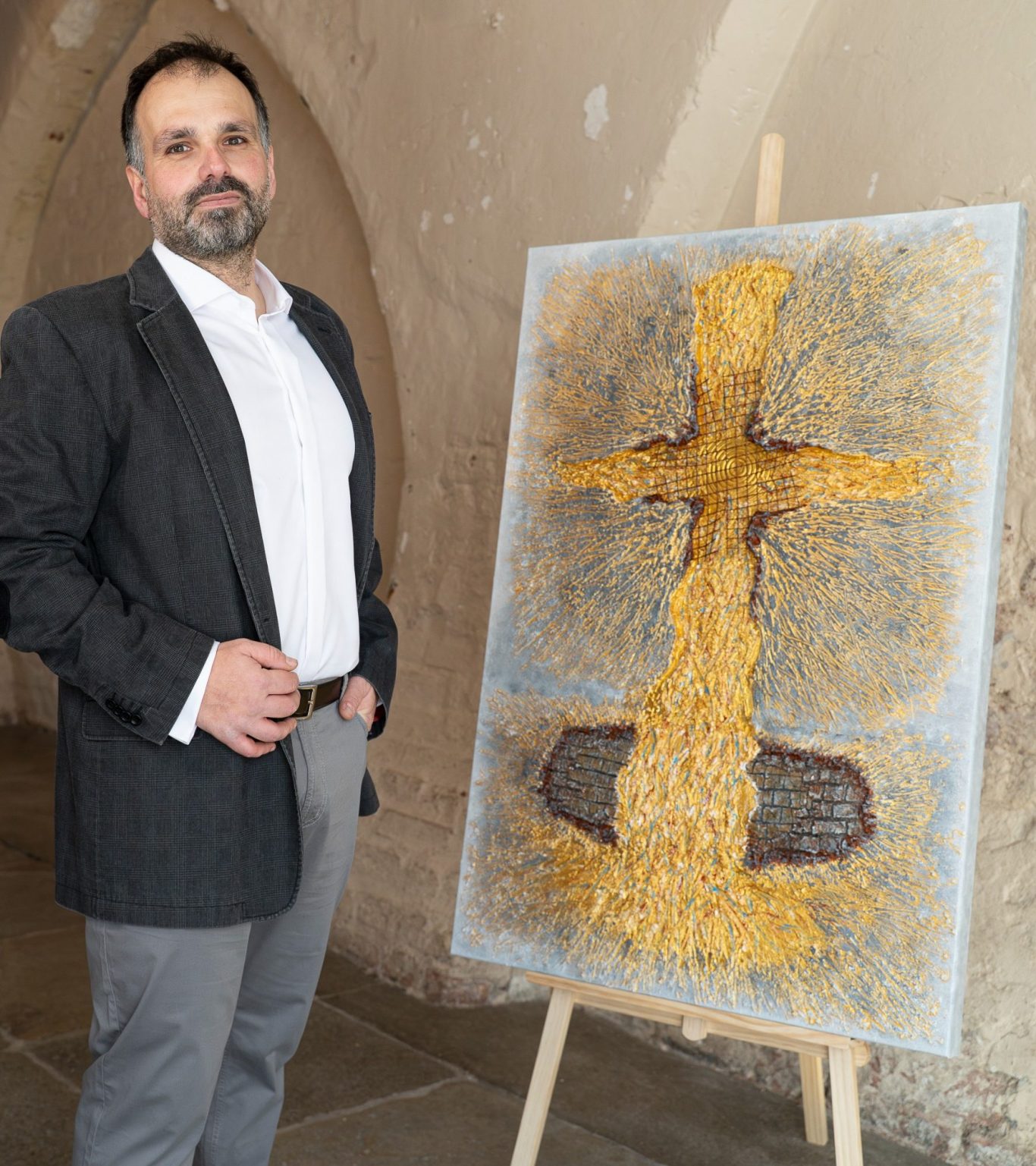
Prison of the Soul
A body-like form stretches across a pale field, surrounded by radiating gold. Its surface is interrupted by exposed grids and dark openings, as though the structure that confines it has entered the body itself. Radiance and injury occupy the same form. It remains unclear whether the figure is breaking apart, holding together or becoming visible through its fractures.
Created in the aftermath of a personal crisis, Prison of the Soul is an early work in which inner pressure becomes material. Wire, relief and metallic pigment make confinement physically present rather than merely symbolic. The painting does not present resilience as triumph. It locates it in the unstable moment when damage, resistance and the possibility of release can no longer be clearly separated.
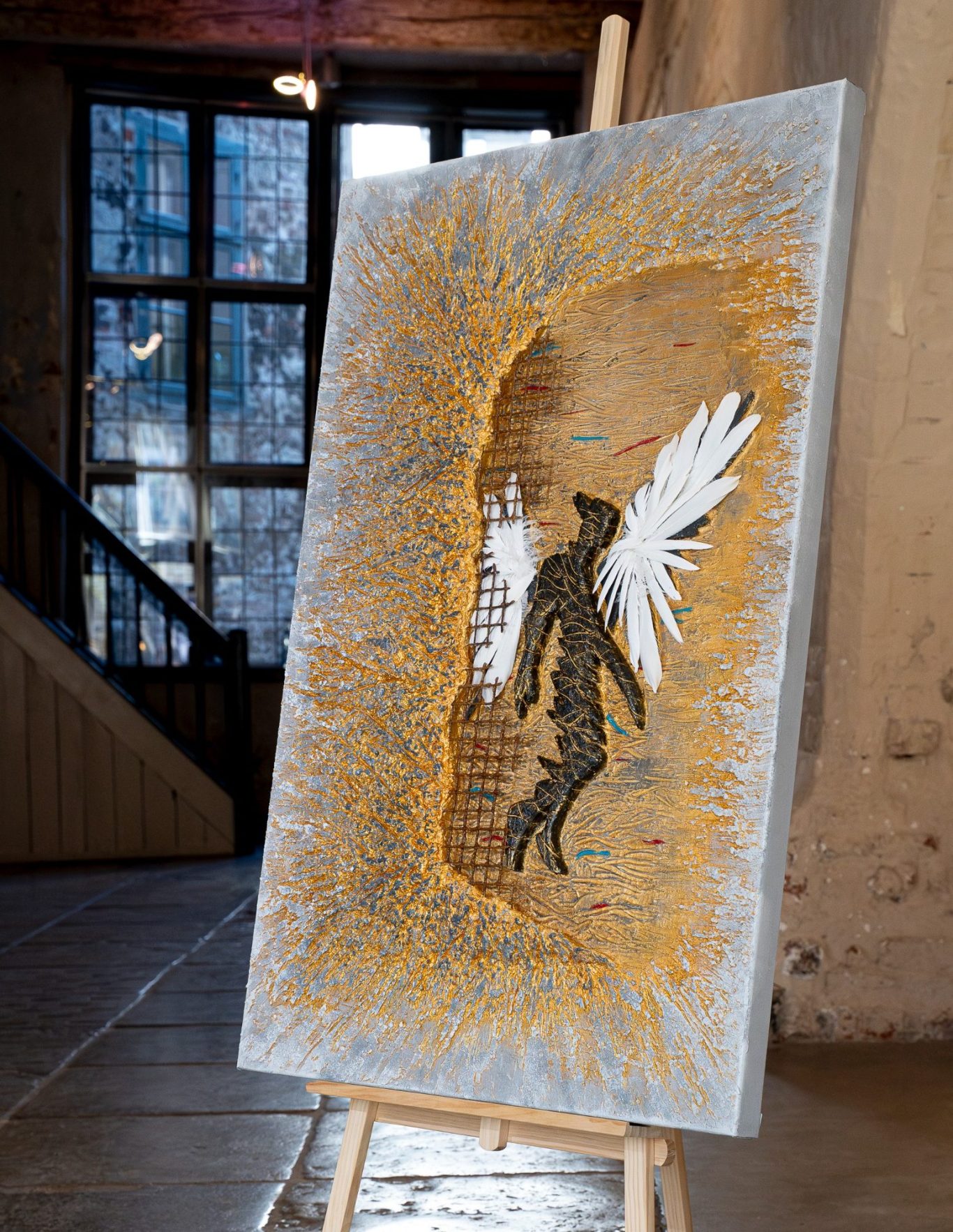
Escape from the Shadow
A dark figure emerges beside a rusted grid, its body still caught between enclosure and open space. White wings extend from its back, sharply visible against a field of gold, yet they do not guarantee flight. One side remains close to the structure from which the figure appears to be separating.
Following Prison of the Soul, Escape from the Shadow shifts from confinement toward movement without presenting release as complete. Wire, relief, metallic pigment and feathers hold resistance and vulnerability within the same form. The surrounding light may suggest emergence, exposure or transformation, but the figure has not left its former structure entirely behind. Freedom begins here as an uncertain separation: the body moves forward while traces of what contained it remain attached.
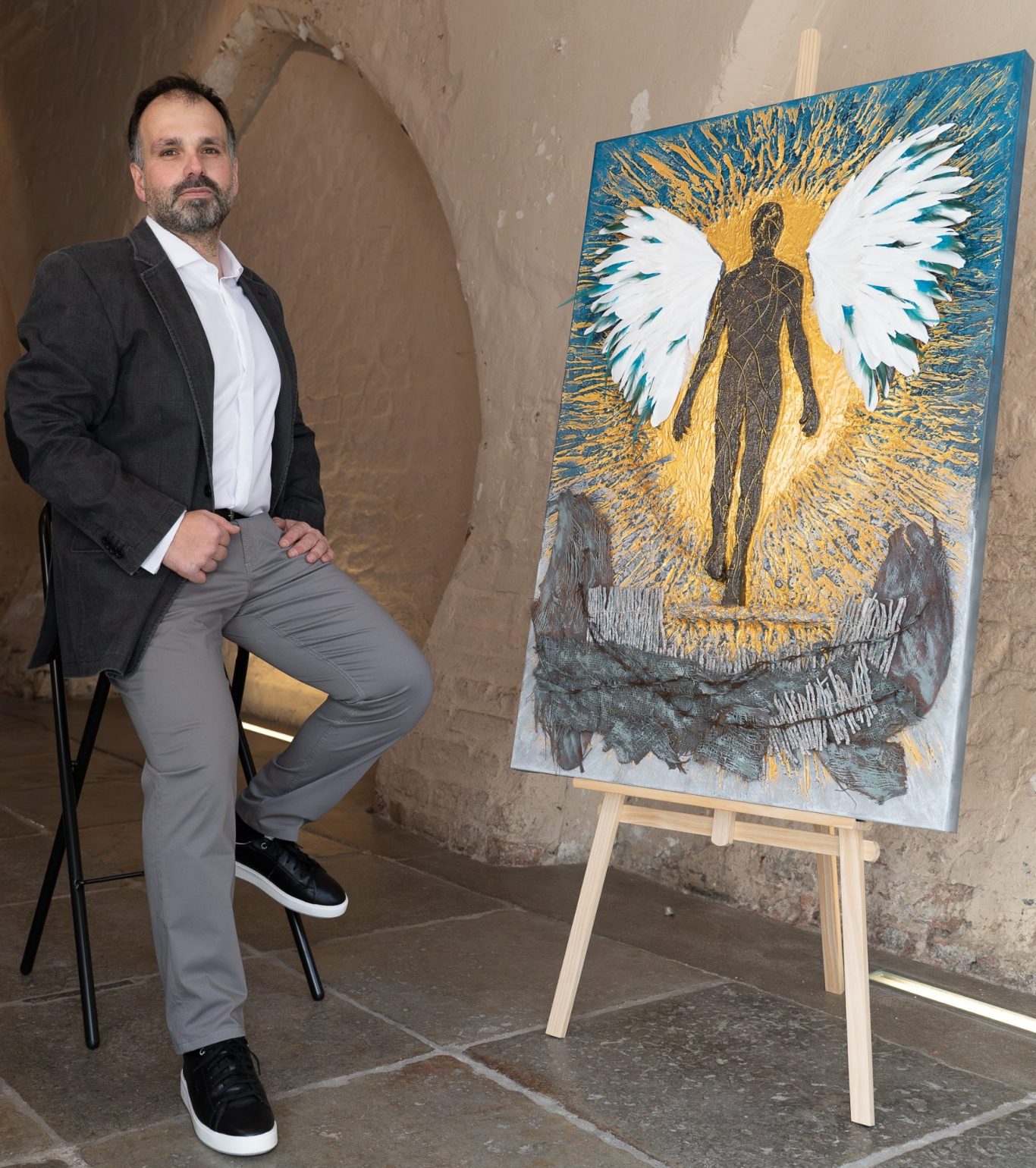
Through the Thorns
A dark figure rises above a dense band of wire, torn fabric and thorn-like forms. Its white wings are fully opened, while fine golden lines run across the body like visible seams, as if the figure had been broken and reassembled without ever becoming whole again. The radiance around it does not cancel the darkness below. It sharpens the figure’s exposure within it.
Following Escape from the Shadow, Through the Thorns moves from separation toward a more fragile form of recovery. Feathers, wire, jute, relief and metallic pigment hold injury and renewal in the same body. The work does not present healing as resolution. It leaves the figure in a state where fracture remains legible, and where strength appears less as triumph than as the ability to continue in a form that still bears its breaks.
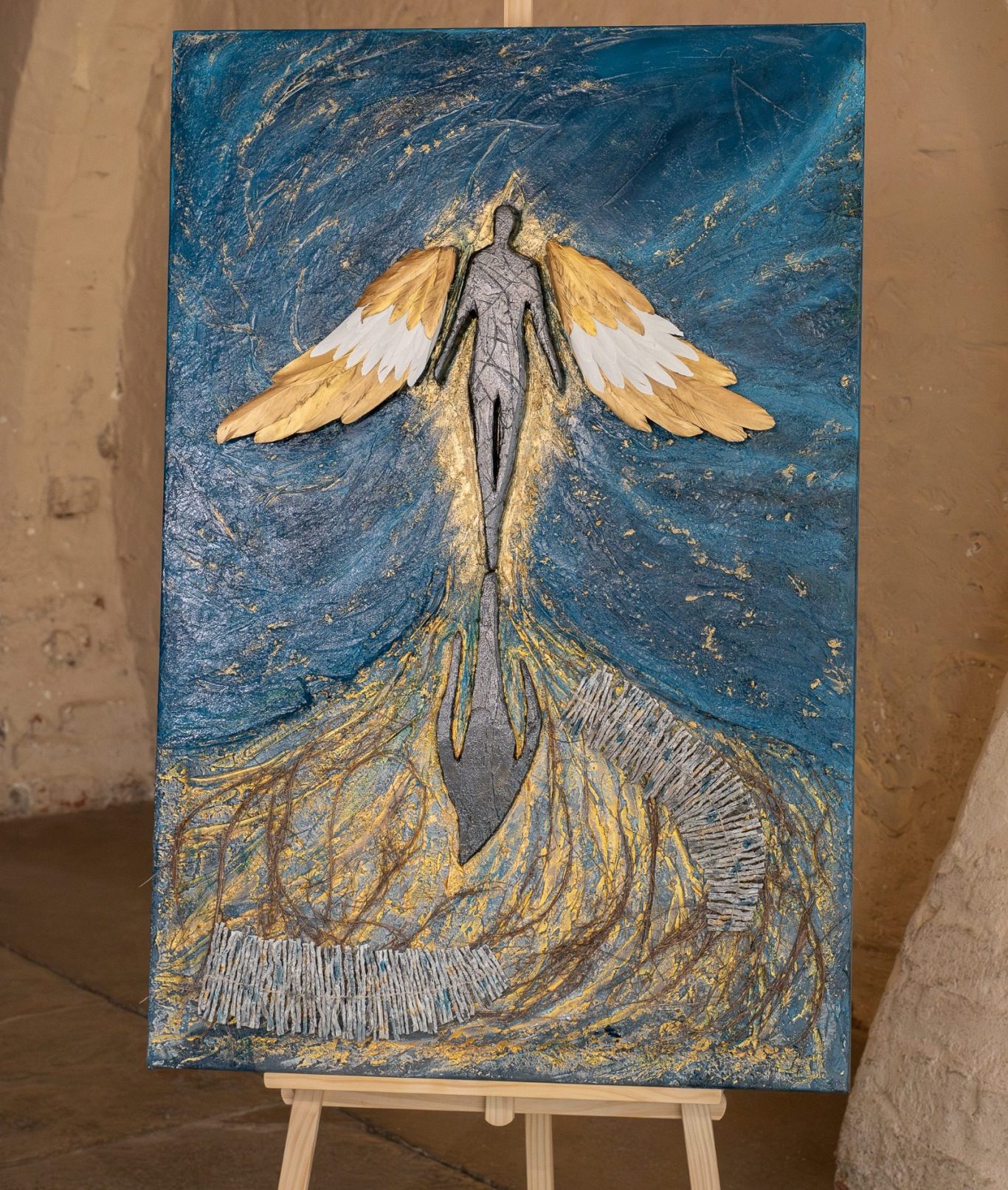
On the Path of Light
A winged figure rises from a dense, root-like ground into a field of deep blue. Its body is crossed by fine golden lines, as if broken parts had been joined again without erasing the fractures. The wings extend outward, but the figure remains suspended between ascent and stillness. Light surrounds it, yet does not dissolve the marks of what came before.
As one of the concluding works in the Resilience and Freedom cycle, On the Path of Light does not present wholeness as a return to an untouched state. Feathers, relief, metallic pigment and the visibly mended figure hold damage and continuity together. The work suggests a form of presence shaped by what has been endured. What stands in the light is not an unbroken self, but a body still carrying the lines by which it has been held together.
From the Personal to the Collective
The questions that emerged in Resilience and Freedom did not remain confined to the individual body. Experiences of pressure, fracture and uncertain recovery gradually opened onto the structures surrounding it: the conditions under which people live together, distribute power and depend on one another.
With Fragile Balance, the focus shifts from inner confinement to collective order. The body remains present, but now within crowds, institutions, damaged architectures and unstable crossings. What was first experienced as a personal struggle becomes a way of examining how protection can turn into control, how trust is constructed, and how freedom and dignity depend on relations that can never be taken for granted.
The transition is not a departure from the earlier work. It is an expansion of its field.