Fragile Balance
Between order and collapse, between longing and control, the works of Fragile Balance unfold. They are the artistic response to societal turning points, political frictions, and the fragile foundations of our time.
This cycle addresses the precarious relationship between democracy, freedom, dignity, and power. It reveals institutional fractures and collective tremors—raising questions rather than offering answers:
- What truly sustains our society?
- What happens when protection turns into control?
- And how much voice remains for the individual amid the noise of systems?
The works presented here are part of an ongoing series. Pieces such as Dictatorship of the Minority and The Burden of the Majority represent only fragments of a larger body of work, each painting a condensation of complexity—neither slogan nor verdict, but an open field for ambiguity and reflection.
Materials such as oxidized metal, barbed wire, jute, charcoal, and marble dust are not decorative—they embody resistance and vulnerability. In their rawness lies opposition; in their rupture lies possibility.
This art does not deliver judgment. It is a mirror.
A place where the political becomes personal—and the personal becomes political.
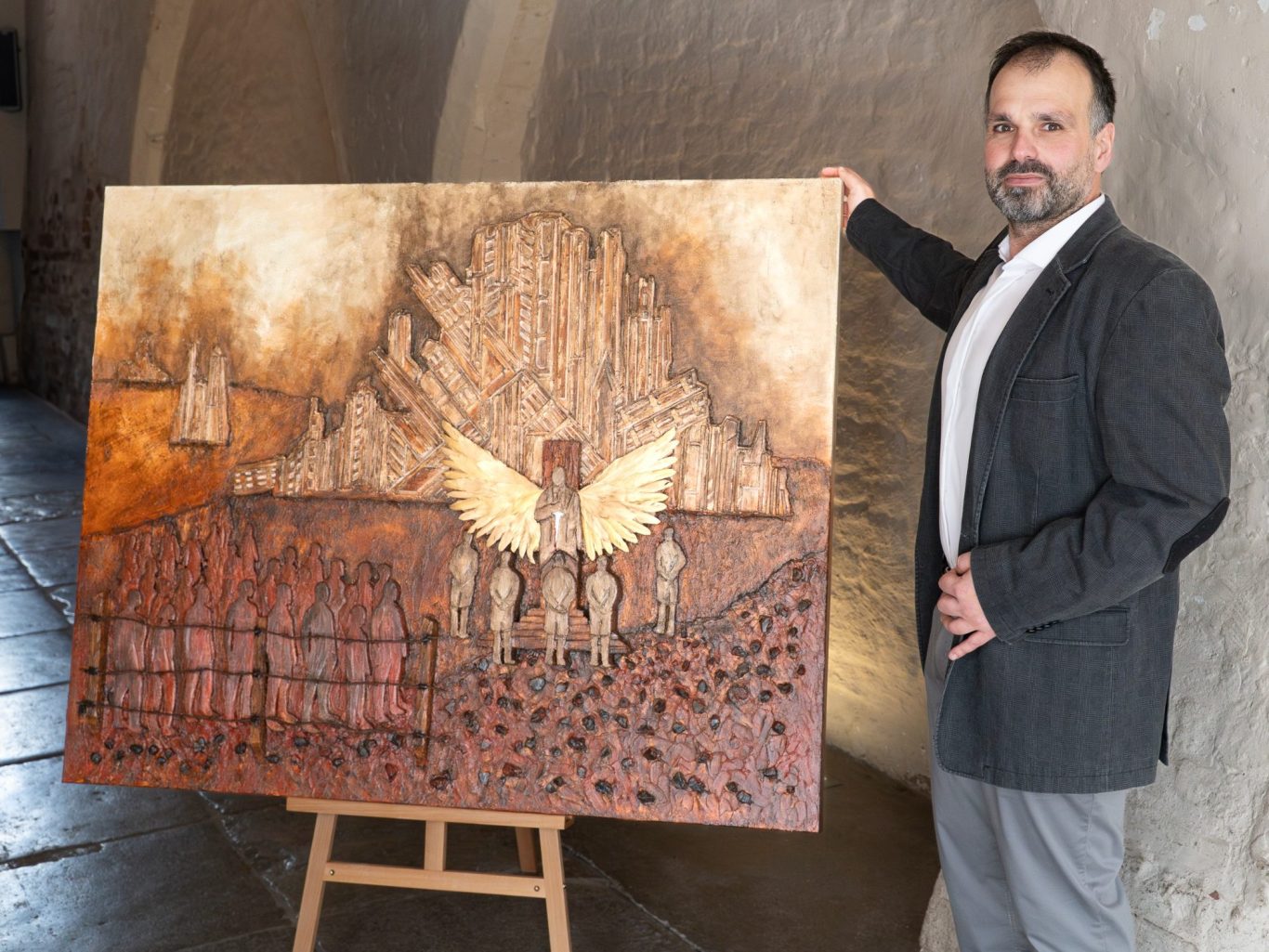
"Dictatorship of the Minority"
This work addresses the silent yet powerful takeover of societal influence by a small, often invisible elite. The composition evokes institutional ruins, fractured foundations, and a torn social body—symbols of a system no longer balanced but strategically distorted.
Rusting wire, marble dust, and charcoal embody both decay and the rigid structures in which we live. The piece is not about assigning blame, but about reflecting on dynamics where a few shape the lives of many—subtly, seemingly legitimized, yet profoundly effective.
As Plato observed, order can only endure if it corresponds to the soul of humankind. Dictatorship of the Minority asks: What happens when imposed order disguises itself as care? When control masquerades as protection?
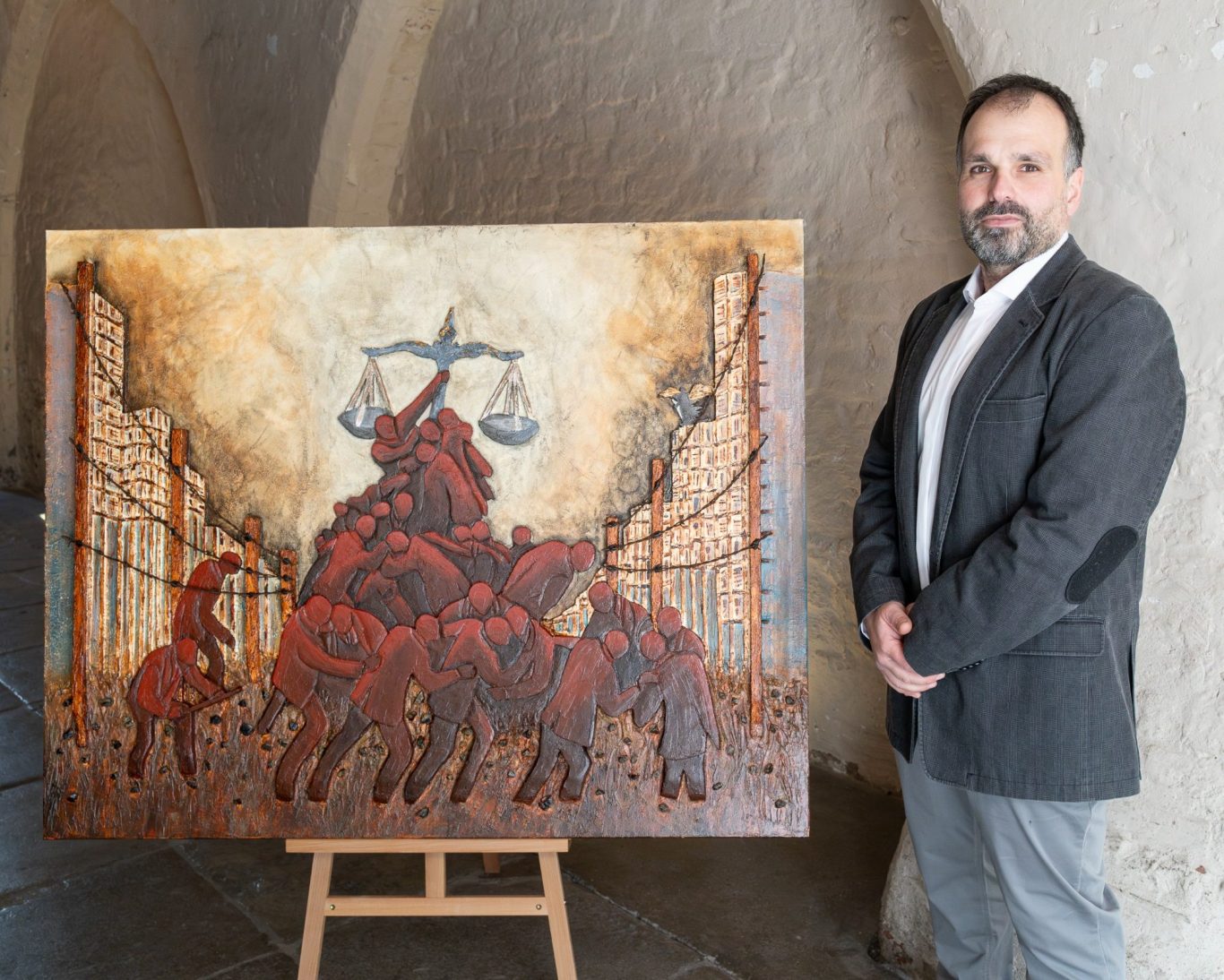
"The Burden of the Majority"
This work speaks to the growing fracture of the majority within systems built on freedom, yet increasingly collapsing under the weight of particular interests. Postmodern singularism, rising individualism, and the pursuit of self-fulfillment at the expense of the common good appear here as broken structures, fragmented forms, and divided surfaces.
The visual language reflects democracy’s paradox: it grants freedom, yet risks being undone by that very freedom once collective responsibility disappears. The mass depicted is oppressive not in its strength, but in its disintegration.
Questions linger: Can societies endure if no one stands for the whole? Is the longing for individuality greater than the desire for community? Is democracy sustainable without loyalty, without shared responsibility?
The Burden of the Majority is less a statement than a mirror—an open reflection on the life cycle of democracies and the fragile balance between autonomy and cohesion.
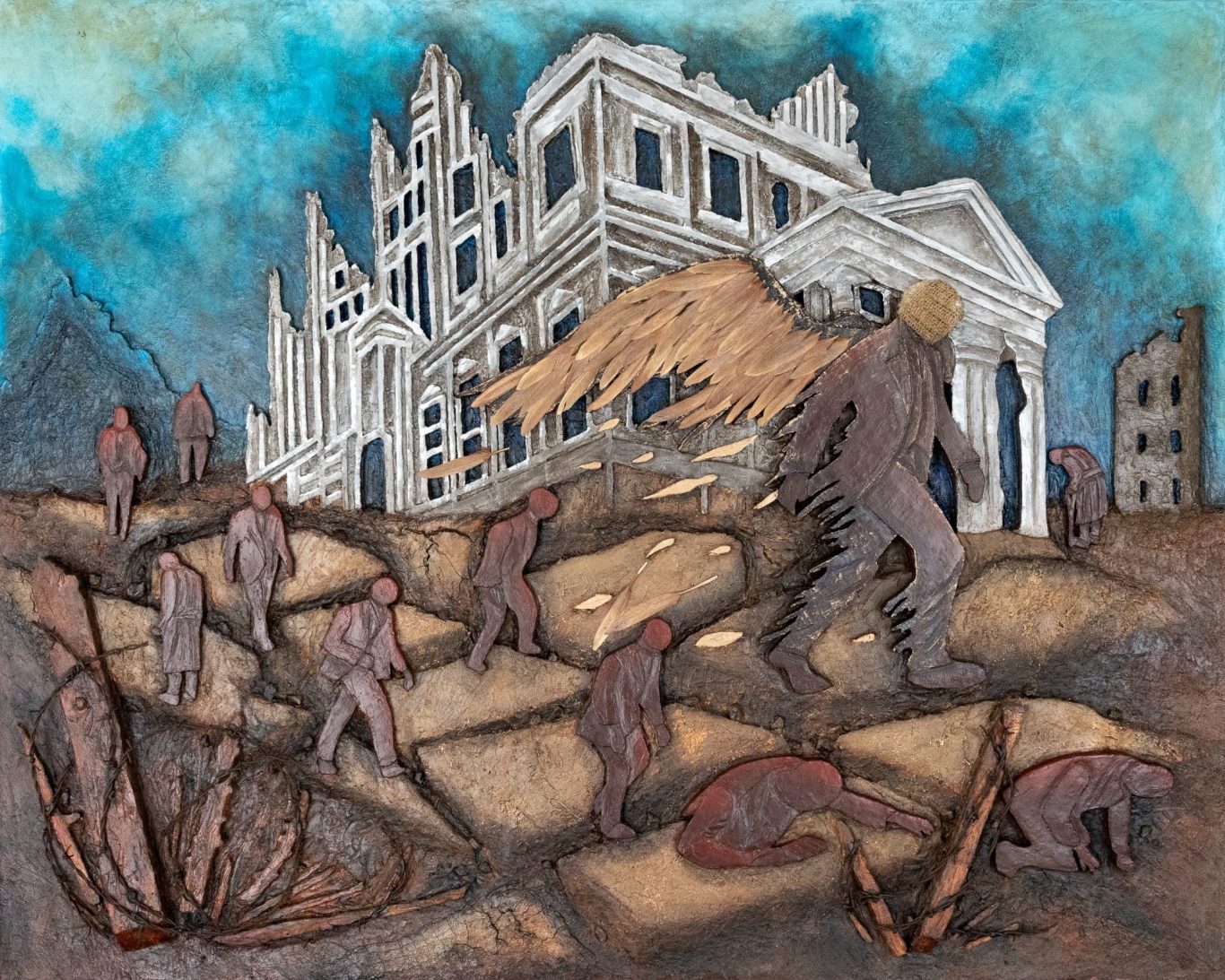
"Wound of Freedom"
What remains of freedom when it loses its form?
Wound of Freedom is the third part of Francisco Prieto’s political-philosophical cycle Fragile Balance, which examines the fragile and often paradoxical condition of democracy—between ideal, exhaustion, and loss of identity.
Here, freedom is not staged as a heroic gesture but as a wounded angel: its golden-rusted wings crafted from real feathers, its body torn open, its head veiled in jute. The figure becomes a metaphor for alienation, speechlessness, and the struggle for identity in an age of societal upheaval.
A dark panorama of urban devastation unfolds in the background—broken institutions and fractured architecture, once symbols of stability, now fragile memories. The path ahead is cracked and lined with barbed wire and coal fragments, symbols of both burden and historical energy.
Small faceless figures creep across the terrain—stooped, erring, fragmented. Their rust-brown tones stand in stark contrast to the piercing blue of the sky. Hope here collides with resignation, movement with paralysis, light with shadow.
Is the angel who leads us still one of light—or already a disenchanted shadow of itself? Do we carry freedom as burden, as wound, or as luminous utopia? Which systems preserve our humanity—and which bind it?
Following Dictatorship of the Minority and The Burden of the Majority, this work marks a central moment of tension: collective disorientation in times of systemic fracture.
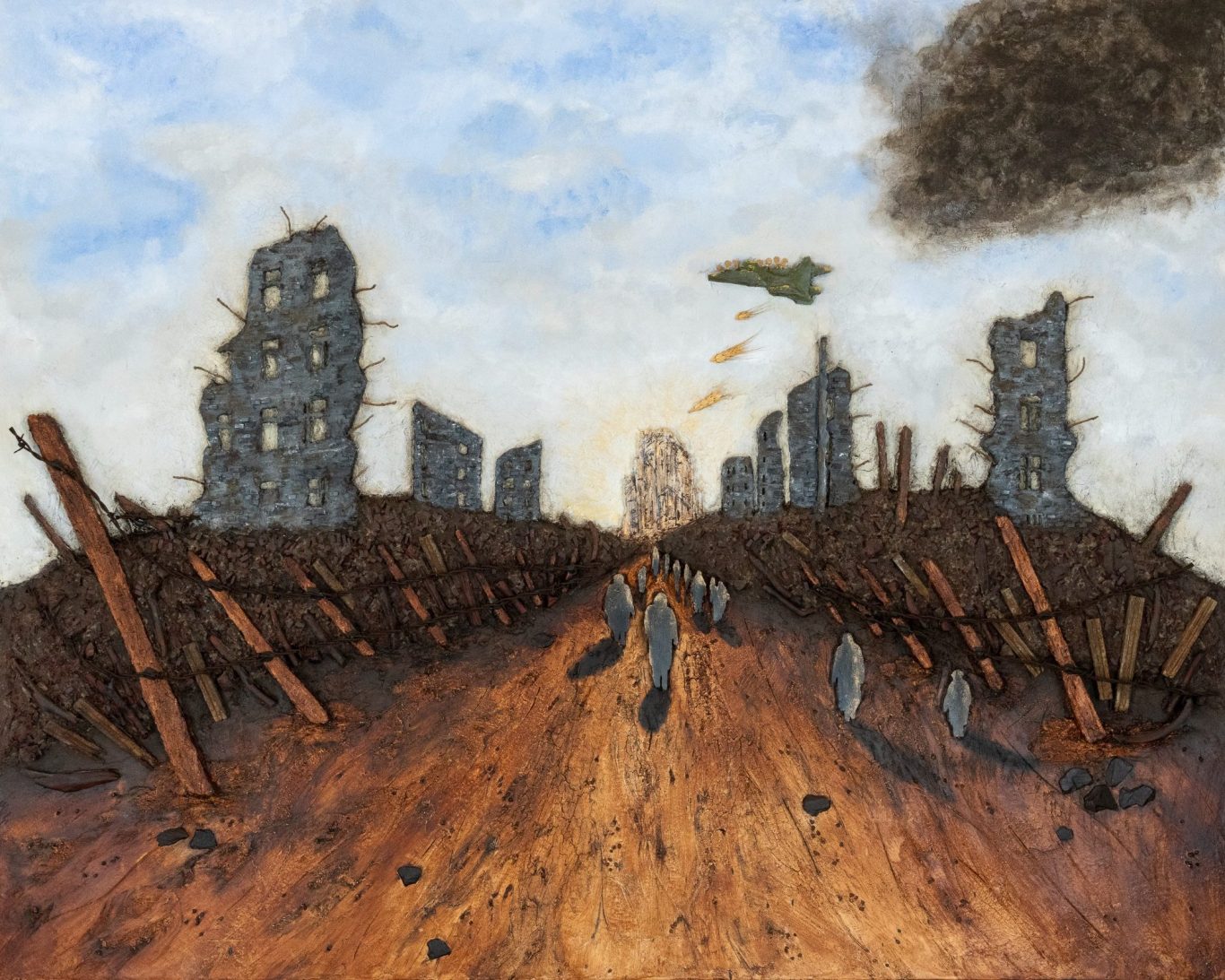
"Path of Dignity"
What remains of humanity when securities collapse?
Path of Dignity closes an existential arc within the ongoing cycle Fragile Balance. The work asks how dignity can be preserved when institutions, structures, and familiar certainties sink into the rubble of history.
A torn path rises from the bottom edge, cutting through coal fragments, ruins, and barbed wire toward a distant, hazy city—illuminated ambiguously, as hope or illusion. Three tonalities of white carry the philosophical weight of the painting: parchment white below (doubt and openness), grey-white in the center (grace, between failure and hope), and bluish white above (awakening, transcendence, ethical orientation).
A faded green airplane drops a tripartite ear of wheat—at once nourishment, hope, and the ambivalence of power. Shadowed figures line the broken path, bent and silent, marked into the surface with coal and rust.
Path of Dignity is not decorative. It is a tactile resonance chamber—inviting viewers to feel both weight and light, ruin and renewal. It is a quiet testament to humanity, to endurance, and to becoming within the unfinished.
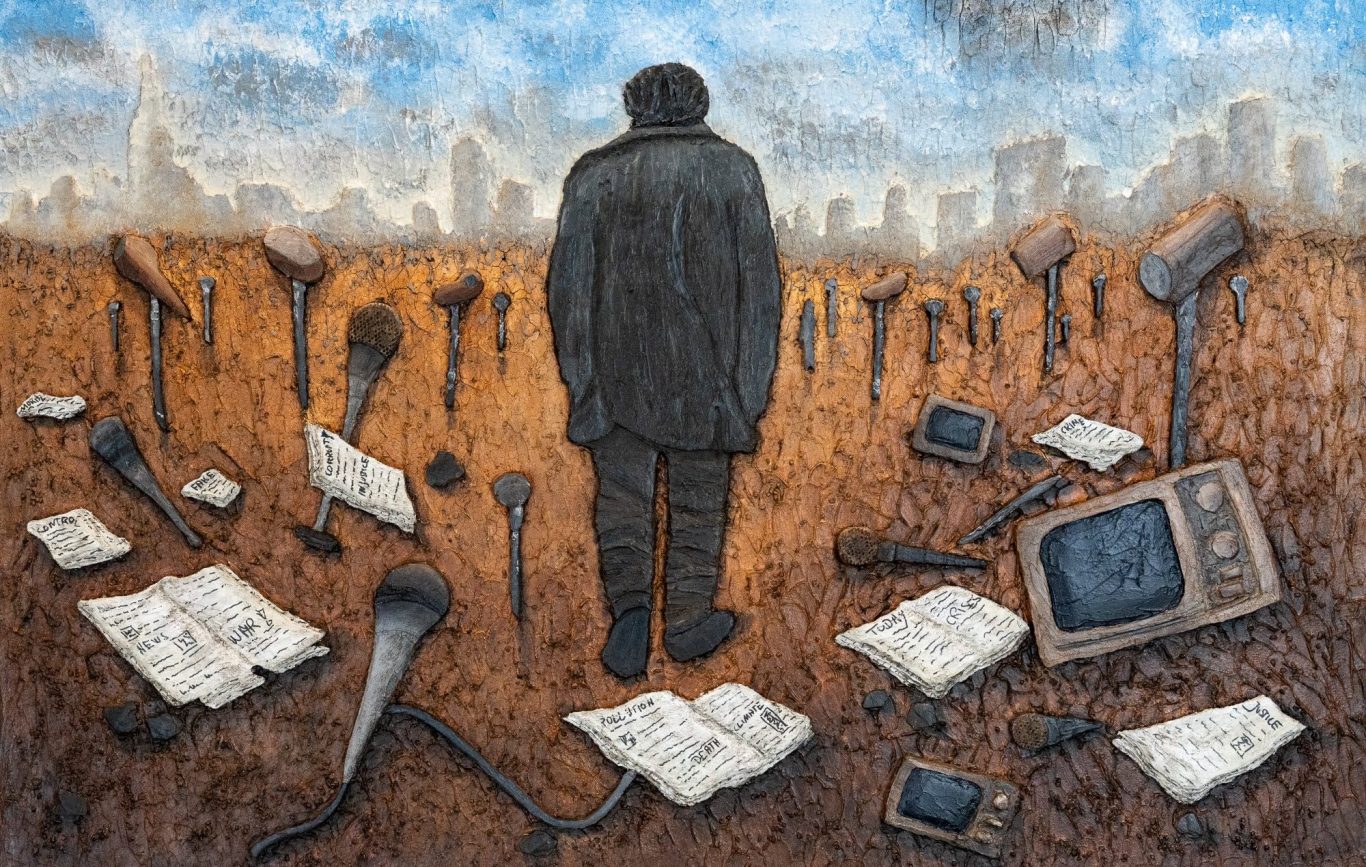
"The Voice Behind the Noise"
How can one preserve a voice when the world dissolves into noise?
The Voice Behind the Noise reflects existential disorientation in a society saturated with media, information overload, and fragmentation. An isolated figure stands upright with its back to the viewer, surrounded by broken microphones, torn newspapers, and shattered screens.
These elements are not symbolic alone, but materially present—embedded in marble dust, coarse pastes, stones, and rusted grids—creating a surface that makes the erosion of perception physically palpable.
The muted earth palette, fused with urban grey and a pale sky, mirrors the tension between groundedness and metaphysical estrangement. Yet the upright stance of the figure sustains a fragile space of resistance and hope.
This work asks: What remains of the individual when truth and deception blur? How does one find orientation when all signs collapse? Can resilience endure in an age of media saturation?
The Voice Behind the Noise is not only a reflection on the condition of the world. It is a quiet manifesto for authenticity, dignity, and the endurance of the human spirit.
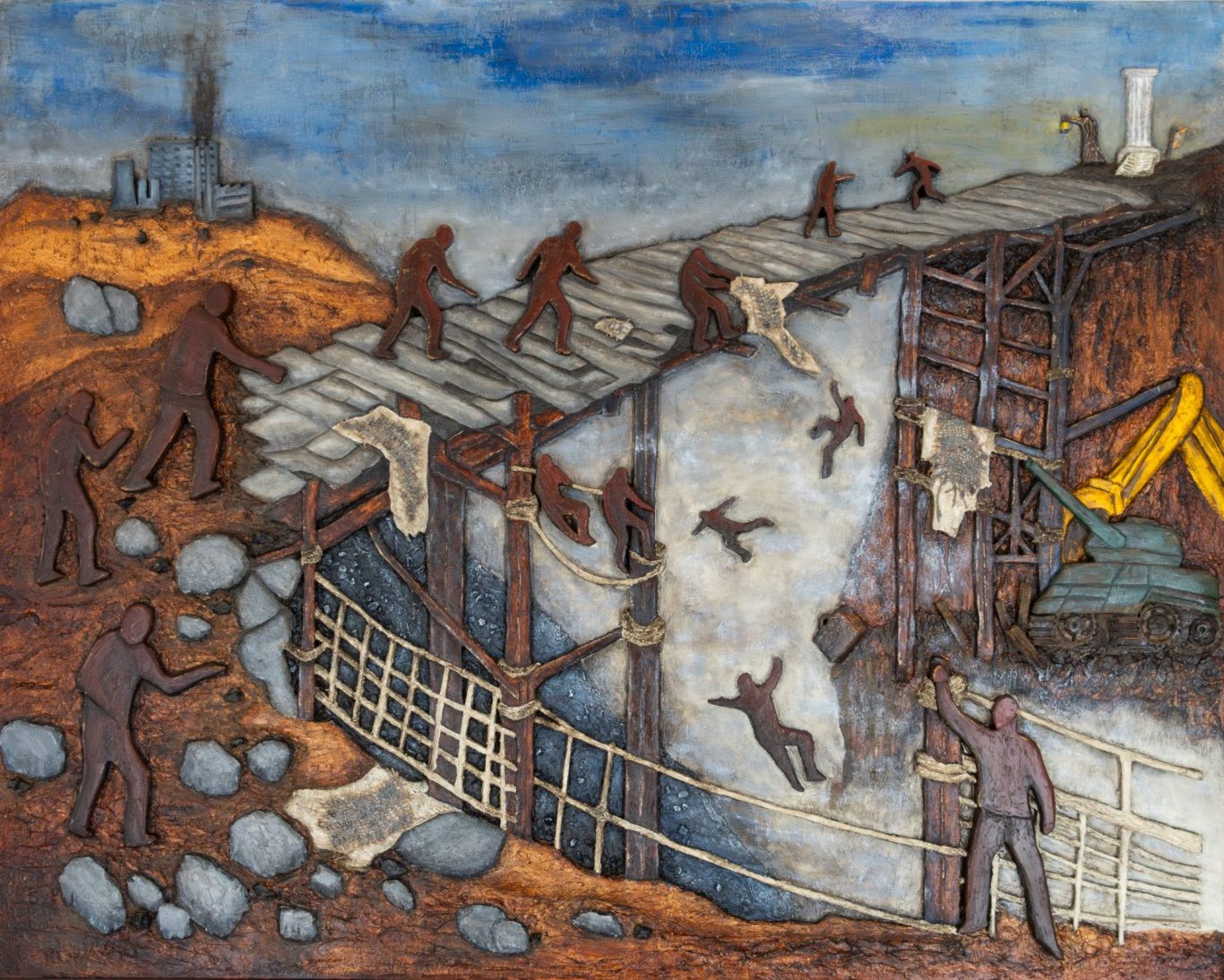
"Architecture of Trust"
With Architecture of Trust, Francisco Prieto expands his ongoing cycle Fragile Balance, which examines the fragility of democratic systems, social order, and human dignity. The work asks: What holds us together in a time when political, social, and emotional bridges seem to erode?
At the center of this large-scale semi-relief stands a fragmented structure—part bridge, part ruin. Upon it, silhouetted figures move carefully, supporting one another yet exposed, embodying the attempt to preserve or rebuild trust despite doubt, uncertainty, and past fractures. A luminous zone at the upper edge, upheld by a translucent column, opens toward hope—but remains ambivalent: is it a beginning, or merely the illusion of one?
The piece enters into dialogue with other works in the cycle, such as Dictatorship of the Minority, The Burden of the Majority, and Path of Dignity. While these address power, collective strain, and the longing for ethical steadfastness, Architecture of Trust focuses on the in-between: the fragile field where trust is never given, but continually renegotiated.
Its layered materiality intensifies this tension: jute signifies vulnerability of connection, ash and coal embody memory and decay, while marble dust and pigment glazes oscillate between weight and light. Foam relief structures create tactile depth, transforming the canvas into a space of reflection.
Architecture of Trust is not a place of certainty—it is a visual essay on the conditions, possibilities, and ruptures of human coexistence.
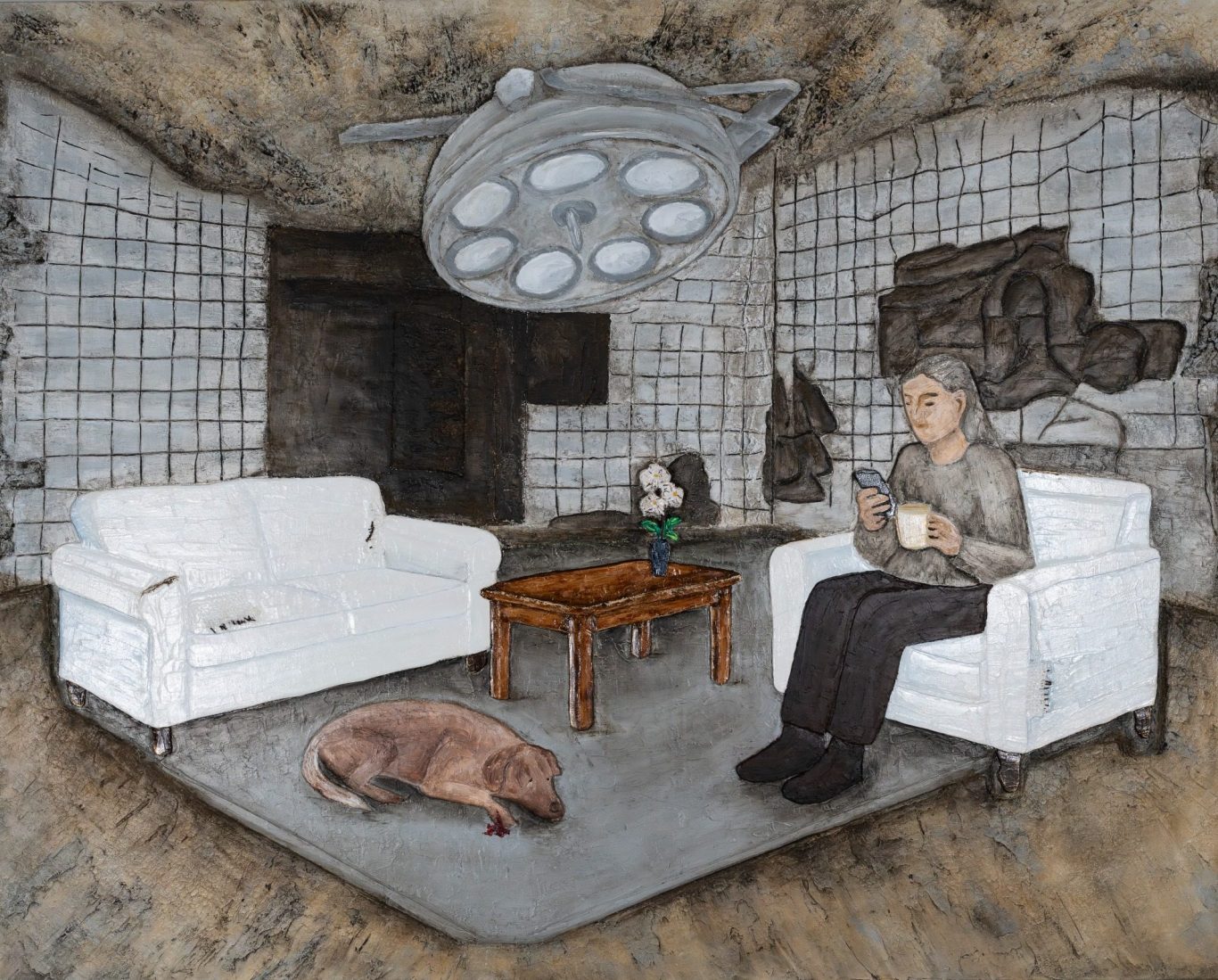
"Comfort of Control"
At first glance, Comfort of Control presents a seemingly ordinary living room—white sofas, a wooden table, a carpet, a centrally placed surgical lamp. Yet the scene quickly shifts from familiar to unsettling: cracked upholstery, sterile tiles, a bleeding dog, and a figure absorbed in smartphone and coffee cup all point to the fragility of security and self-mastery.
The work addresses the ambivalence between outward stability and inner alienation. The room is more than a domestic space—it becomes both diagnosis and model, exposing the aesthetics of discipline and the loneliness of control. The surgical lamp functions as a metaphor for surveillance, echoing Michel Foucault’s analysis in Discipline and Punish. At the same time, the distracted figure evokes Byung-Chul Han’s The Burnout Society, where subjugation arises not through coercion, but through endless self-optimization.
Materiality reinforces the theme: relief structures, ash, marble dust, and fragile pigment layers create a surface that is at once ordered and eroded, smooth yet vulnerable.
Symbolic elements heighten the tension:
- The wounded dog – unspoken loyalty, emotional injury
- The orchid – beauty as sterile consolation, perhaps artificial
- The interior itself – a psychological portrait of a society caught between comfort and the fear of collapse
As one of the final works in Fragile Balance, Comfort of Control turns the gaze inward—toward the fragile balance between individual vulnerability and systemic façade. It is a quiet yet insistent piece, marked by formal rigor and poetic disruption.
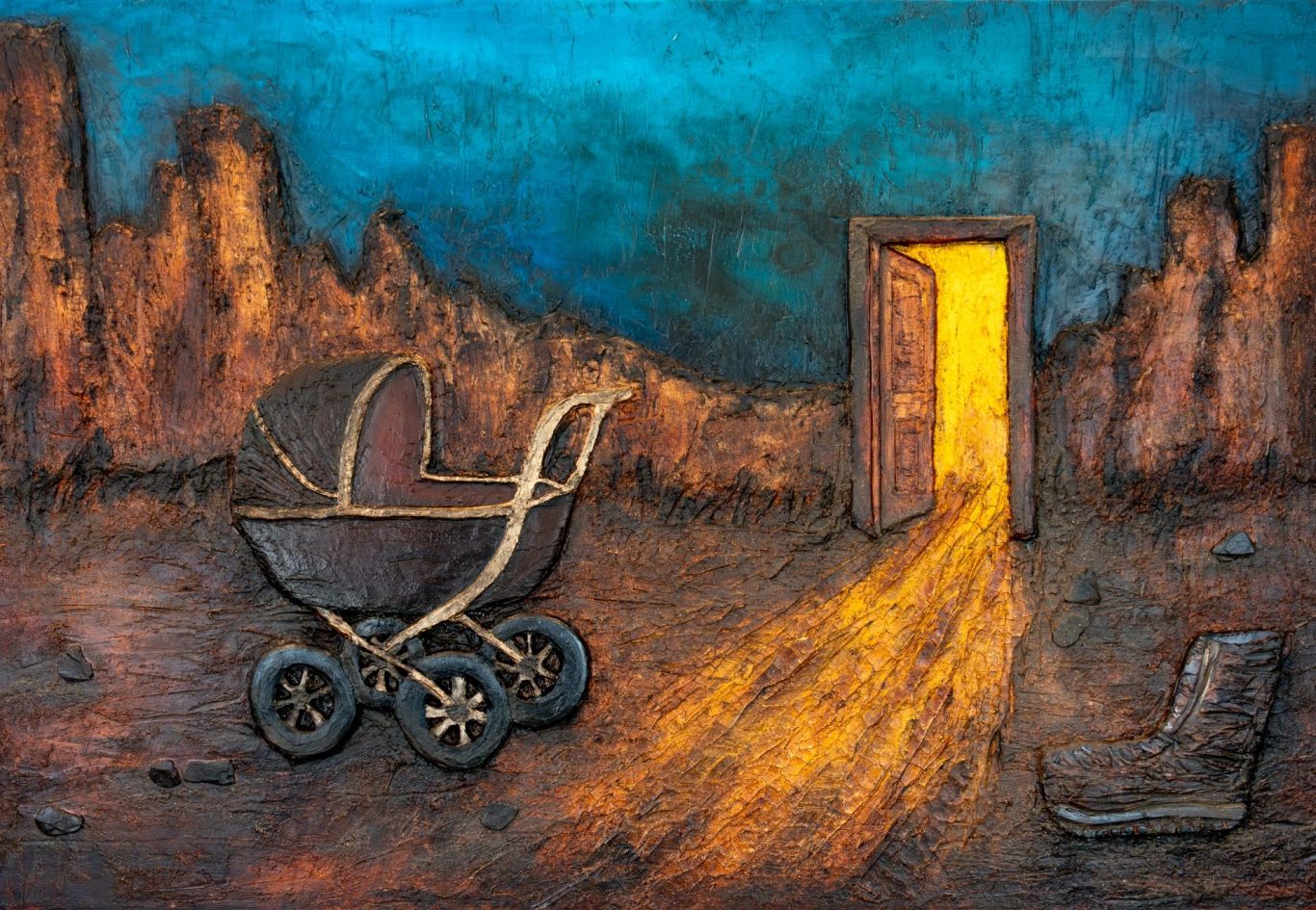
"The Door Without a Name"
The Door Without a Name marks the conclusion of Francisco Prieto’s cycle Fragile Balance—a body of work that has become both a personal journey and a central artistic statement. Emerging from the confrontation with uncertainty, thresholds without direction, and the fragile persistence of hope, this work reflects on endings as well as beginnings.
At its center stands a relief of an empty pram—laden with meaning, yet devoid of presence. It evokes care reaching into emptiness, waiting for what has not yet taken form. Surrounding textures of marble dust, ash, and pigment bear traces of devastation and renewal alike. Embedded stones appear as fragments of a shattered world, and simultaneously as anchors of a possible new order.
A golden aperture fading into cold blues opens the closed surface—an unnamed door, a threshold that promises as much as it withholds. The work asks: Which doors do we step through when the familiar breaks? Can pain become the source of strength? Is hope conceivable without uncertainty?
Unlike earlier works in the cycle, which dealt with resilience, power structures, or social fragility, The Door Without a Name turns toward the threshold itself—the fragile balance between loss and possibility. Its materiality underlines this tension: marble dust and pigments shift between heaviness and light, ash signifies impermanence, while embedded stones embody the weight of reality.
This is not only an image but a tactile threshold—an open, ambiguous passage where fragility and promise coexist.
Conclusion - Fragile Balance
Fragile Balance is part of an ongoing inquiry into the condition of our time. These works do not provide solutions, but tensions. Not answers, but questions. Through their materiality and composition, they mirror the struggle for justice, responsibility, and belonging.
- What holds a society when its foundations begin to crumble?
- Where does control begin—and where does freedom end?
- And what remains when balance itself collapses?
From here, my artistic journey continues in a new medium.
The questions raised in Fragile Balance extend into my photographic practice, where I explore systemic rhythms and invisible boundaries. In the cycles System Clock and Urban Thresholds, I shift from material surfaces to urban spaces, documenting how architecture, transit, and solitude reveal the same fragility—this time in black and white.